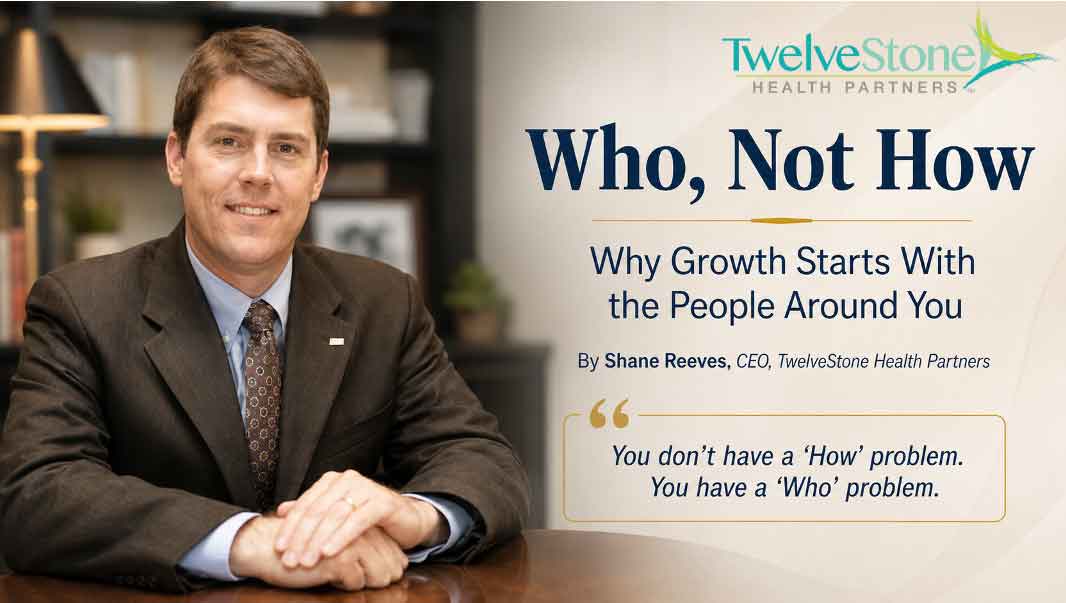
By Shane Reeves, CEO, TwelveStone Health Partners
In my mid-30s, I was burning the candle at both ends.
At home, my wife and I were raising three young children. At work, I was trying to build a small pharmacy company—and I had my hands in just about everything. I was the pharmacist, mixing tech, salesperson, delivery driver and janitor. I even filed the claims so we could get paid.
Like a lot of entrepreneurs, I thought growth meant working harder, learning faster and figuring out how to do more myself. Eventually, that approach caught up with me.
I knew I needed help managing my time and gaining some perspective on my strengths and weaknesses, so I joined Strategic Coach, an entrepreneurial coaching program in Atlanta. During one of my first sessions, I explained how badly I wanted to grow the company and how exhausted I had become trying to make it happen.
My coach listened and said something I have remembered for more than 25 years: “You don’t have a ‘How’ problem. You have a ‘Who’ problem.” That simple statement changed the way I thought about leadership.
Ask a Better Question
When we’re faced with a problem or opportunity, our first instinct is usually to ask, “How am I going to do this?” Strategic Coach founder Dan Sullivan later formalized the idea as “Who Not How”: rather than assuming we need to personally figure out every challenge, we should first consider who has the talent, experience or passion to help solve it.
For me, that meant accepting something that seems obvious now but wasn’t obvious to me as a young entrepreneur: My job wasn’t to become great at everything. My job was to surround myself with people who were exceptionally good at things I wasn’t—and then give them the opportunity to use those gifts.
Great Teams Need Different Strengths
Over time, I came to believe that one of the greatest competitive advantages any organization can have is a team of “A” players with complementary strengths. Research supports that idea. Gallup has found that employees who learn their strengths become 7.8% more productive, while teams that focus on their strengths everyday experience 12.5% greater productivity. (Gallup)
But “Who Not How” isn’t simply another name for delegation. It’s about recognizing when someone else is better equipped to tackle a challenge—and being secure enough to let them. The best leaders don’t need to be the smartest person in every room. They identify the person best suited for the problem at hand and give that person room to lead.
Trust People Enough to Let Them Grow
Finding the right “Who” doesn’t accomplish much if we refuse to trust them. Sometimes it feels faster to step in and solve the problem ourselves. We know how we’d approach it and doing it ourselves gives us a sense of control. But every time we automatically provide the answer, we should consider whether we’re also taking away someone else’s opportunity to grow.
Research on workplace leadership consistently points to the importance of autonomy and competence. A 2026 meta-analysis covering 192 studies found that leadership practices supporting employees’ autonomy, competence and connection were associated with stronger motivation, engagement and job satisfaction. (PubMed)
That matters at TwelveStone. Our work ultimately affects patients and families, so developing capable, confident people isn’t separate from our mission. It’s part of accomplishing it.
Growth Requires Us to Work Differently
TwelveStone has come a long way from the small pharmacy where I once wore nearly every hat. As we continue to grow, we can’t simply work harder or move faster. We have to work differently.
We have incredibly talented people throughout this organization—people with experiences, perspectives and abilities that no single leader could possess.
Part of being a great teammate and leader is recognizing those talents and creating opportunities for people to use them.
So, this week, consider where you may still be trying to do too much yourself. Is there work someone else could do better? Is there someone on your team whose abilities aren’t being fully used? And are you solving problems for people when they would benefit more from solving those problems themselves?
More than 25 years after that coaching session, I still occasionally catch myself asking:
How am I going to do this? When I do, I try to stop and ask a better question:
Who?
As TwelveStone enters its next chapter of growth, that question will matter more than ever.
We don’t need one person who can do everything. We need talented people who trust one another, recognize one another’s gifts and give each other opportunities to shine.
And sometimes, the “Who” you’ve been looking for is already right beside you.